Saturday, April 15, 2006

2006 Georgia State Championship

I've decided to play in the 2006 Georgia State Championship from May 5-7 at the scenic Emory University campus. I haven't played tournaments since last year. I'll be playing a completely new opening repertoire for the first time (that as of this post I know maybe half of). And I'll be fighting against the Curse of Emory. So it looks like I have nothing to lose :)

I scored 2.5 out of 5 in last year's championship. It should be fun!
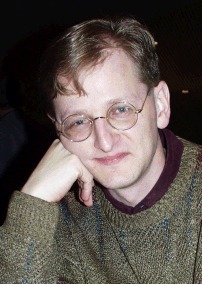

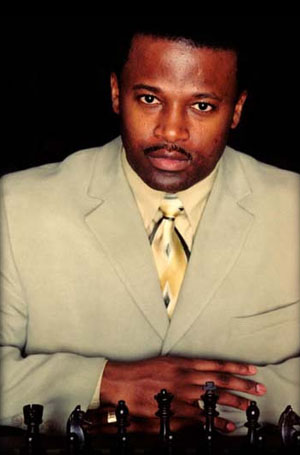
FM Miles Ardaman
2005 Georgia State Champion
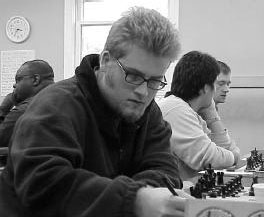

FM Todd Andrews
2004 Georgia State Champion
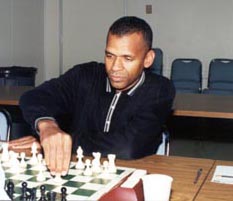

FM Stephen Muhammad
2003 Georgia State Champion
Monday, April 10, 2006

A New Beginning


I have taken a break from chess since the new year. Part of my decision was because I had used up all my vacation time for work on taking Mondays off after weekend tournaments, and was unable to take my customary week off between Christmas and New Years. But mainly it was because I needed a break.

I've made some significant practical decisions about how chess fits into my life.

1) I have completely revamped my opening repertoire. Previously I opened with 1.e4, playing many main lines. With Black I responded to 1.e4 with 1...e5, mostly main lines, and a Nimzo-Queen's Indian system against 1.d4. I'll go into my new repertoire at a later date, once I actually start playing it in tournaments. For now I'll say that 99% of my opponents won't have prepared for the lines, they are minimal in theory, and still very playable.

2) I am going to have fun. I had fun before, but there was also a lot of grind associated with my chess preparation. I did the Tactics Boot Camp. I drilled tactics and opening variations regularly. Weekend tournaments were gruelling affairs where I tapped into my energy reserves by the third day and completely exhausted myself (hence my Mondays off from work). Okay, I'm getting old(er). Vital-physical conditioning is now assuming a top priority in my preparation. I have this crazy idea that the more balanced my entire being is, the better I will play, even without constant drilling. I want to look at a game of chess as something that can't really be prepared for. I want to forget everything I know when I sit down to play, so that I can simply be there. I want to see a position for what it is, with a clear and empty mind, not filled with rules and ideas all competing with one another. A chess game is a sculpture being carved by two players. Each move gives it more shape, removing more and more possibilities.

I have seen many chess games in the A class (and below), where the winner is the player who maintained a clearer focus in the later parts of the game. Four hours go by and both players play some hard chess. Very complicated tactical struggles resolve down to an endgame with a few minor pieces and pawns remaining, and both players are tired. I have noticed that the consistent winners of class sections are not always the flashiest players. Some of these winners I even feel that I can generally outplay them. They are good enough to hold on and survive to the endgame. But by then I am tired, and they maintain their focus. And they beat me almost every time. There's a lot to be said for this. They are the better chess player and competitor, simply because they get the full points. I want to feel fresh in the late middlegames and endgames. I believe so many lost games can be drawn and even won, and many drawn games can be won in these phases of the game. This is the area I want to focus my study on. It's not boring. It's ripe with possibilities.

I'll let you know how this goes. I'm not yet sure when I'll start playing tournaments again, but it will definitely be a new beginning for me.

Wednesday, February 01, 2006

I'm Not Dead Yet!


Since several people are asking, I haven't given up chess. But I am taking a breather from the intense study and playing I had been doing. It had started to become a grind and I needed a break. I still play a weekly online slow game with Fussy Lizard, buy and read new chess books (an addiction all its own), and keep up with the big super-GM tournies, such as Wijk aan Zee. My USCF rating dipped back into the B class from my last couple of tournaments, and I don't want to play in them again until I'm serious about my preparation and play.

Monday, November 21, 2005

My Game With Topalov


The sun had just gone down, and the three chess sets were on a long table outside in front of a train car. An excited crowd murmured in anticipation. At table #2 was Mickey Adams and Vishy Anand. At table #3 was Alexander Morozevich and Judit Polgar. And at table #1 sat Veselin Topalov and an empty chair.

I knew it would be a tough game, but soon I would be able to say that I had played the World Champion. I sat down across from Topalov, when he looked at me and said in his Bulgarian accent, "Do I have White or Black?"

"Um..., I'm not sure," I said.

"Do I have White or Black? We can't play until I know."

I looked around for the pairings sheet and found it. Sure enough it said Topalov and I would play on board #1, but it didn't specify the colors. The other pairings had clear notations for who had what color. At the time it didn't seem unusual to me that colors were specified in this way. I only noticed that my game with the chess great was being held up. I frantically started looking for Scott, the TD, to resolve the issue.

The other players started their games. Topalov sat back impatiently. I asked people where Scott was. Nobody could find him!

Time passed and soon the reporters were interviewing Topalov as I sat on top of the train car, dejected. My game with Topalov was not to happen.

And then I woke up.

Wednesday, September 28, 2005

2005 Georgia Class Championship

A rough tournament for me after not playing in several months. I scored a sad 1.5 out of 5 in the A section, and 1 of those points was a full-point bye in round 2. The A-section was small, and I had to play Black three times in a row (not that color choice makes a whole lot of difference at this level).

Some highlights:


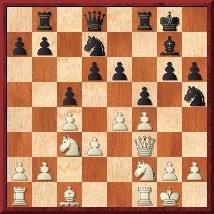
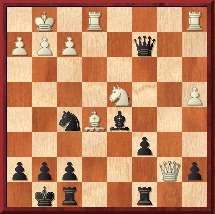
Kilgore (1826) - Kinsler (1893)
White to move

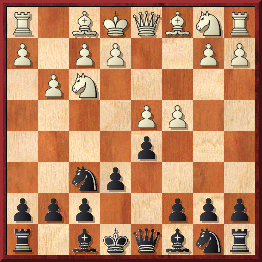
I saw a way to grab a pawn with 14.exf5! exf5 15.Qd5+ Kh7. But now I began to worry that after 16.Qxd6, Black could trap my queen with 16...Bxc3 17.bxc3 Nhf6. Saving the queen (and the won position) is not that hard once you are willing to let her stay on d6 for awhile. For example, 18.Re1 Re8 19.Bd2 Rc8 20.Rxe8 Qxe8 21.Re1. I didn't see all this during the game, so I played 16.Re1?? because taking on d6 looked too scary. Another psychological factor I've experienced before is that initially my plan on extracting my queen was based on 16.Qxd6 Nhf6 17.Nd5, and 16...Bxc3 ruins that idea. Discovering 16...Bxc3 at the last moment, I began to worry that he could indeed trap my queen and didn't stop to make a detailed practical analysis.


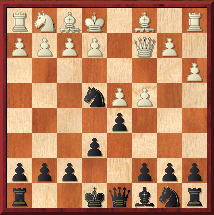
Kostrinsky (1884) - Kilgore (1826)
Black to move

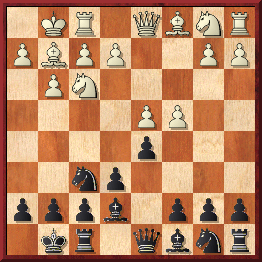
I've gotten myself into a bit of trouble here. White's about to win back his piece and will be a pawn up. Then I found 17...Bxf2+! If 17.Kxf2 then 17...Qc5+ and I can save my light-squared bishop. My opponent played 18.Qxf2 and I got out of the mess with even material. This game should have been a draw, but I misplayed the endgame.


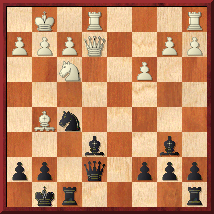
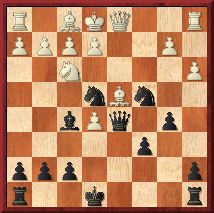
Bedell (1966) - Kilgore (1826)
Black to move

I managed to win a piece after 21...Nxd4 22.Bxd4 Qg6 23.g3 Qd3 24.Re3 (24.Qb2 is better, but allowing my queen to f3 is not an easy thing to do) Qxd4. Confident that I would now beat this 1966 player, I responded to 25.Rae1 with 25...Qxa4?? whereupon he equalized with 26.Qxc8! Ouch. I'll skip the next part where I donated a queen to the cause. One of my worst chess moments ever.


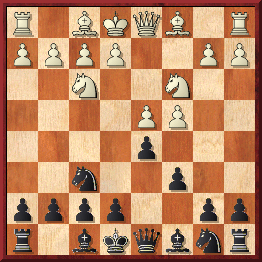
Cano (1866) - Kilgore (1826)
Black to move

Here's a Nimzo-Indian. I played 7...e5, the main line. At the time, having never played this line before, I wondered whether 7...e5 was the right move, or if I was confusing it with another line. I calculated that Black had nice compensation if White takes on e5, and feeling rather reckless from my lackluster tournament performance so far, I decided to go for it and at least go down fighting. The game continued 8.dxe5 Nc6 9.Nf3 Bf5 (the point of 7...e5) 10.Qb3 Na5 11.Qa4+ c6 12.cxd5 Qxd5 13.Be3 Nc4 14.Bd4 b5 15.Qd1.


Cano (1866) - Kilgore (1826)
Black to move after 15.Qd1

Now who wouldn't love this type of play with the Black pieces? Later my opponent offered a draw in a position I probably should have played on, but eager to have some positive score where I actually played, I agreed to the draw.

Thursday, August 25, 2005

Gary Southerland

The Georgia chess community lost a long-time chess teacher and tournament director last week. Gary Southerland passed away in his sleep. I did not know Gary very well, but I'd seen him at all the GCA tournaments and spoken with him a few times. The next issue of Georgia Chess magazine will remember Gary. The upcoming Georgia Class Championship is also being named the Rueben Hand, Gary Southerland Memorial. He clearly had a passion for chess, and he will be missed.

Memorial Service Information (to be held August 30)
Newspaper Obituary

Friday, August 12, 2005

Dynamic Play

Consider the following three positions:


Slav
1.d4 d5 2.c4 c6 3.Nf3 Nf6 4.Nc3


Open Catalan
1.d4 Nf6 2.c4 e6 3.g3 d5 4.Nf3


Semi-Open Catalan
1.d4 Nf6 2.c4 e6 3.g3 d5 4.Nf3 Be7 5.Bg2 0-0 6.0-0

What do they all have in common?

A main line move in each position is ...dxc4. What's going on here? Why is Black voluntarily giving White the center by removing that nice pawn on d5 which controls e4?

The answer is time.

In the Slav position, Black wants to develop his light-squared bishop before playing ...e6, but to do so immediately would invite cxd5 followed by Qb3 and Black is in trouble on the queenside light squares. In all three cases, it will take a few moves for White to recapture the c-pawn (in the Catalan positions White has to do so without the light-squared bishop since he wants to fianchetto it). While White is busy getting his pawn back, Black has a little extra time to develop his queenside and bring his pieces to active squares. Sometimes White will truly gambit the pawn and bet that the dynamic activity he gets will more than make up for Black's measly one-pawn advantage.

Is Black's position so cramped that he has to give up the center just for a few tempi? Can't he find a way to develop his pieces and retain the central tension? Won't Black just be worse without any lasting advantage for giving up the center? What is this dynamic compensation that Black receives?

Will you give up a structural/static advantage (or accept a structural/static weakness) for temporary dynamic play? This is a difficult concept to truly grasp and have the confidence and technique to use. After all, if you let your dynamic advantage fade away you're just left with a structural, long-term weakness.

I reached this position in a tournament game:


Kilgore - Tillis 2004

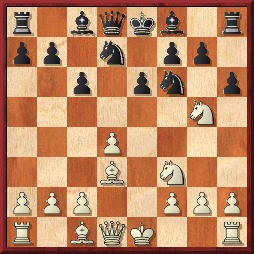
Black has just played 7...h6. In case you don't recognize the position, it was also reached in Deep Blue - Kasparov 1997, a game which Kasparov quickly lost. I knew immediately that I was supposed to play 8.Nxe6! White sacrifices material for dynamic compensation in the form of Black's king getting stuck in the middle and a long-lasting initiative. But I sat there and thought for about 15 minutes. A single thought kept going through my head. "Do I have the technique to make this dynamic compensation count?" I finally decided that I would never forgive myself if I chickened out, so I played 8.Nxe6! There's no forced mate or winning back of the material. If I let Black untangle himself, I'm simply down the material.

What would you do?

Do you like to play dynamic chess?

I drew the above game, after winning back the material plus a little more, but in mutual time trouble with a fairly balanced position I played it safe and offered a draw (one thing I am good at in chess is blundering in time trouble). I was still satisfied with the game on some level because I did maintain the initiative for a long time and eventually converted it into a material gain.

Yes, playing dynamic chess is scary, but it's also fun. And I believe it's an essential part of becoming a stronger player at some point.

Monday, August 08, 2005

Into the Lion's Den


How do you play a superior opponent?

I'm talking about someone rated way above you. 400+ points above you.

Do you play cautiously, trying to survive for as many moves as possible, praying for a draw?

Do you try to make the game as boring as possible, and hope to wear out your opponent?

Do you recklessly go for the kill, figuring that since you'll lose anyway you might as well have some fun?

Or is your approach more subtle, where you basically try to play your best, but:

- You play more conservatively, trying to keep it safe, avoiding complications for fear your opponent can navigate them better.

- You welcome complications, figuring there's more chances for your opponent to mess up.

One thing's for sure: Your higher-rated opponent wants to win. They won't be happy with a draw. Many times this translates into them taking unnecessary risks and making mistakes.

The 2005 Atlanta Chess Center Championship is August 19-21, and it is a little unusual in that the Open section goes all the way down to 1800. This means I'd be playing in the Open section and potentially facing players I've only seen on the upper tables until now.

I've only ever played in an Open section once before, at the 58th Annual Tennessee Open last year. Now that was a blast. Rated 1691 at the time, I beat two experts and gave a FIDE Master a rough time in a long game I eventually lost. I went into each game believing I could beat them all (well, to be honest, I was too nervous at the start of my game with the FM to believe much of anything, so nervous I accidentally knocked over two of my pieces on one of my opening moves!). This was also during the peak of my tactics bootcamp training.

While it's still up in the air as to whether I'll play this upcoming tournament (still recovering from bronchitis, and I don't want to play unless I feel 100%), I can't help but feel an extra element of excitement at the thought of so-called mis-matched pairings in the early rounds of these Open tournaments, because every now and then you get an upset or two.

Friday, July 15, 2005

Peach State WoW

The 2005 Peach State Open is next weekend, July 22-24, and I'll be playing in it.

What chess study and playing have I done since Emory?

Well, I'm afraid I've been sucked into the World of Warcraft, an MMORPG, affectionately known as Warcrack.

At least finally the age old question can be answered: Is Warcraft suitable training for weekend Swiss tournaments?

I'll let you know.


Not me, but you get the idea.

Saturday, June 25, 2005

How To Lose To a Grandmaster in 22 Moves


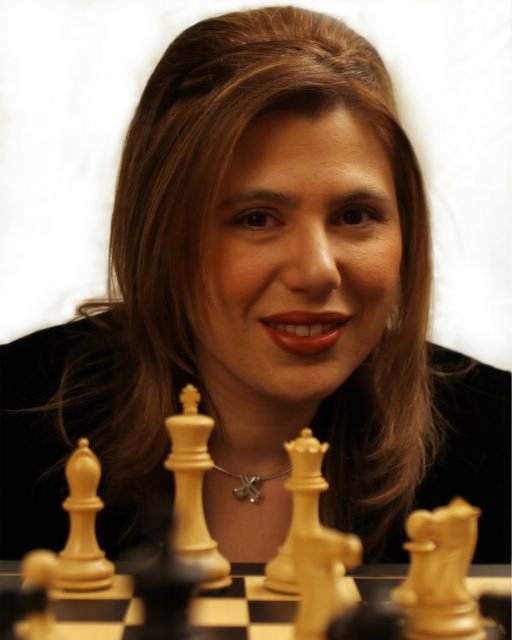
GM Susan Polgar gave a simul last night in Stone Mountain Georgia (just north of Atlanta). This was the first time I've played a GM, much less a world class GM, and it was a lot of fun. I believe she won all the games, and we had some strong players from the House of Pain there to play.

Check out Susan's blog from June 21-25, 2005 for posts with photos of her visit to Atlanta.

You can see how she demolished me here.

Friday, June 17, 2005

Atlanta Chess Center

The Atlanta Chess Center is the place in Georgia to play in USCF tournaments. Known as The House of Pain by its regulars, they have finally gotten something resembling a real web site up and running. Yay!

http://www.atlantachessclub.com/

Thursday, June 16, 2005

This is the End

I've been watching IM Timothy Taylor's 5-part series on How to Defeat the Weaker Player, and the final article has arrived. And this one covers endgame play. This may be my favorite article of the bunch, for many times it will work against the stronger player.

Taylor spells out the need to study endgames very convincingly:

Let’s say you get no attack (HOW TO DEFEAT THE WEAKER PLAYER 2); let’s say you get no special opening advantage (HOW TO DEFEAT THE WEAKER PLAYER 3); let’s say your experience gets you nowhere in the middlegame (HOW TO DEFEAT THE WEAKER PLAYER 4); then all is not lost, for the ending is the most difficult part of the game, and it’s the hardest part of chess to play well without experience.
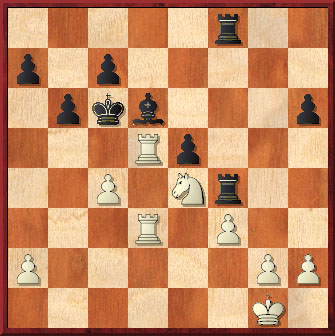
I can't tell you how many times I've played games like that. No opening advantage (or it fizzled out). No killer tactics. No big middlegame advantage. Pieces trade down. No major activity by anybody. Draw? Sure.

I remember one blitz tournament game (out of the two blitz tournaments I've ever played in), where I had a K+P vs K. I saw right away it was a dead draw. But my excitable opponent didn't understand the opposition and I soon promoted the pawn. Most endgames aren't that simple. Many times you need to visualize a winning endgame after a forced sequence of trades. Here's an example from a fairly recent tournament of mine:


Cope (1985) vs Kilgore (1741)

White has just played 30.Red3?? Black can now force play into a winning endgame. Can you find it? The solution is here.

I still feel that I have a lot to work on for my endgame (don't we all?), and that many of my "boring draws" can turn into wins if I become much better in endgame play.

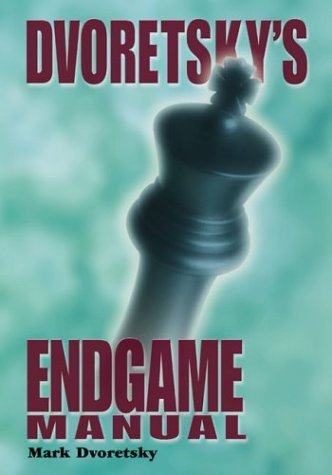
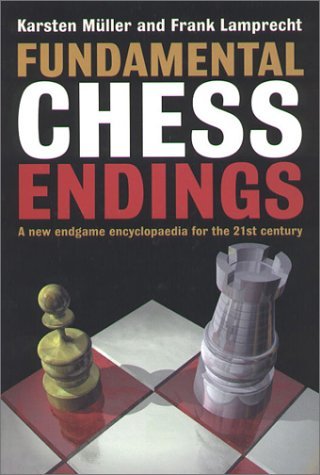
My current favorite endgame books are:


Wednesday, June 15, 2005

Curse of Emory

I played at the Emory Castle Grand Prix tournament for the second year in a row. And once again turned in a poor performance, scoring 2 out of 5 points. 2 out of 5 might not sound so bad, until you realize that I was playing in the U2000 section, and all of my opponents were B players playing up!

Round 1 - Paul Davis (1756), draw. A Sicilian Moscow where I felt I had a slight edge through most of the game, but was unable to convert it to a win. Paul is one tough defender.

Round 2 - Bryan Tillis (1647), I lost. A Glek Four Knights where I turned down a draw offer, found a neat tactic that should lead to a win if I had found the followup tactic. But I didn't, and after playing my last 10+ moves with 1 second on my clock, I finally resigned in a lost endgame. Great job by Bryan who never gave up.

Round 3 - Madhu Nair (1623), I won. A Spanish Berlin (without the queen trade) where I missed a simple tactic that almost got me into real trouble, but I found the sharpest continuation that presented all sorts of problems to solve for my opponent. He missed the best continuation and I soon traded down to a winning endgame.

Round 4 - Joshua Mu (1648), I lost. An Exchange Alekhine. Little kids who can't sit still in their chairs with a 1648 rating are not supposed to understand the subtleties of positional pawn sacrifices! Yet Joshua did, and I fell for it, munching a pawn and then struggling to survive the rest of the game. Joshua piled on the pressure and converted to a nice win. Very impressive.

Round 5 - Myles MacDonald (1648), draw. A double-fianchetto Reti where I forgot to consider such matters as pawn structure, and walked into an IQP position. Still, it had been played before by strong players, so I went with it, aiming for dynamic piece play, controlling the square in front of the IQP, and always looking for an opportune moment to push the pawn. But it quickly turned into a hanging pawn position when I got away with a major bluff: Myles made a move to prevent my pawn push, and I pushed it anyway. There were tactics if he munched the pawn incorrectly, but one line we both missed allowed him to safely keep the pawn with no compensation for me.

Lessons Learned
  1. The amount of time I've studied chess in the last two months? Zero. And it's showing. I also haven't played any, except for a weekend tournament a month ago. My non-chess interests have exploded recently (playing guitar, which I used to do professionally, digital home recording, and World of Warcraft). I'm in the process of putting together a realistic study-plan to try and keep my chess muscles exercised.
  2. A week of chess camp inspires players to perform well in the tournament. Maybe I should take part in the chess camp. It's mainly kids, but some adults do participate. Taking a week off from work to receive training by GMs and IMs sound like a blast.
  3. It doesn't matter if all my opponents were B-class players. Sure, my rating will take a dive, possibly back into B, but I should be able to beat players below 1650 if I deserve to be in A. I'll come back again next year, until I finally break the Curse of Emory!


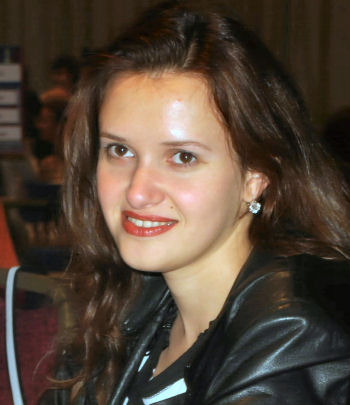
WGM Anna Zatonskih (co-winner)

I could say my poor performance was due to being distracted by WGM Anna Zatonskih, sitting in my direct line of sight several times, but the truth is, I sucked at chess. The open section was won by WGM Zatonskih and GM Becerra.

Wednesday, June 08, 2005

2005 Emory Castle Grand Prix


IM Jonathan Schroer, last year's winner

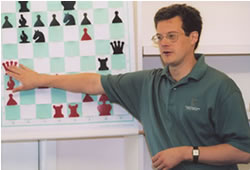
This coming weekend is the Fifth Annual Emory Castle Grand Prix. It culminates a week-long chess camp, where students (mostly kids, but adults can participate, too) receive intense chess-training for a week. Imagine receiving chess lessons from a variety of GMs and IMs all week long, and then playing in a Swiss weekend tournament afterward.


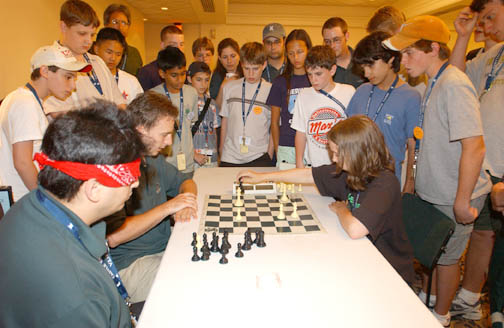
GM Julio Becerra, playing blitz...blindfolded

This is my second time playing in this tournament (I haven't signed up for the chess camp yet). Last year was tough. All my opponents were young kids whose ratings were deflated (there's a whole controversy about scholastic players having deflated ratings compared to the rest of us -- I try to stay out of it) and their brains were on fire from all the chess instruction they'd just received. I scored a dismal 1.5 out of 5 and lost a bunch of rating points. And from some other adult players I've talked to, their experience was very similar to mine. So I figure it's time to get back on the proverbial horse and jump right back in. Worst case is getting to watch a bunch of well-known chess players battling it out.


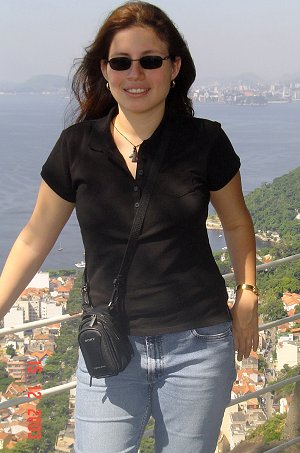
WGM Martha Fierro

The camp instructors include: GM Yuri Shulman, GM Julio Becerra, GM Gregory Serper, GM Boris Kreiman, GM John Fedorowicz, WGM Martha Fierro, WGM Anna Zatonskih, IM Carlos Perdomo, IM Jon Schroer, FM Alex Dunne, FM Andrew Whatley, NM Richard Francisco, Gary Southerland and Jim Mundy.

Friday, May 27, 2005

2005 Georgia State Championship

The Georgia State Championship was held this year at Emory University from April 29 to May 1. We had a decent turnout, fairly close to last year's numbers.


FM Miles Ardaman

FM Miles Ardaman won the championship section.

Lester Bedell won the U2000 section.

Hartley Chang won the U1600 section.

The GCA elections were held between the 4th and 5th rounds for the "member-at-large" position. Surprisingly, only one of the candidates, Steve Schneider, showed up to give a speech. Guess who won.


Steve Schneider

I played in the U2000 section and didn't have so great of a tournament.

My first game was quick and easy. It lasted 30 minutes, of which I spent 2 minutes on my 13th and final move (all my previous moves were known theory).

My second game was a Moller Attack where again my opponent wasn't up on the main line theory, and I was soon up a free pawn.

My third game was a bizarre Center-Game against the U2000 champ Lester Bedell, and I thought I handled the opening and early middlegame quite well. Then I made a few innacuracies and White equalized. Finally, amidst extreme fatigue I made a stupid one-move blunder and threw away the game.

In my fourth game I faced the French Rubinstein, and even though I managed to stay awake throughout this exciting opening, it resulted in a draw as Black had most likely planned.

My fifth game was another howler. I played well and then got tired and missed multiple opportunities to easily win, finally blundering the endgame and I lost.

I attribute the fatigue on my 3rd and 5th games to not having fully recovered from my flu a month ago, but there are still some valuable lessons in all of my games, so it was worth it.

The crosstables are here.

Three of my games are amongst those here.

Thursday, May 26, 2005

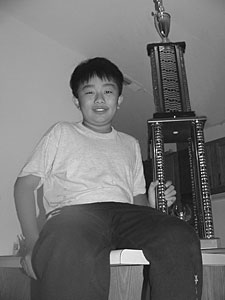
Xiao Cheng Wins Scholarship


Xiao Cheng
(Photo by Daniel Lucas)

Awards Given to Winners of "SuperNationals" Competition In Nashville Over the Weekend RICHARDSON, Texas (April 11, 2005) — The University of Texas at Dallas (UTD) awarded three separate full-tuition-and-fees, four-year scholarships to the top performers at the “SuperNationals” of chess competition held in Nashville over the weekend. The winners of the scholarships, each of which has a cash value of about $48,000 to non-Texas residents, were Joel Banawa, a 15-year-old from Los Angles, Ray Robson, a 10-year-old from Largo, Fla., and Xiao Cheng, a 15-year-old from Alpharetta, Ga. The only stipulation is that the winners must meet UTD’s rigorous entrance requirements at matriculation.

From GCA Web Site.

Monday, May 23, 2005

HB Global Chess Challenge Results

Lester Bedell scores highest of all people I've ever played with 7 points in the U2000 section.

Congrats, Lester!

Here's how players I've seen in Georgia tournaments did in this 9-round tournament:

Open
GM Wojtkiewicz, Alek - 6 points
lost to WGM Anna Zatonskih in round 2
lost to GM Gata Kamsky in round 8

FM Ardaman, Miles Ferdi - 6 points
lost to GM Alexander Stripunsky in round 2
beat GM Gregory Serper in round 7

FM Muhammad, Stephen A - 5.5 points
drew with GM Alexander Stripunsky in round 4
drew with GM Alexander Shabalov in round 5
beat GM Igor Glek in round 6
lost to GM Joel Benjamin in round 9

GM Becerra, Julio - 5 points

IM Burnett, Ronald - 5 points

Cheng, Xiao - 4.5 points
lost to GM Joel Benjamin in round 1

Gulamali, Kazim - 4.5 points
drew with GM John Fedorowicz in round 1
lost to GM Zviad Izoria (winner of open section) in round 3

GM Fedorowicz, John - 4 points
drew with Atlanta's own Kazim Gulamali in round 1

Pohl, Klaus - 4 points

FM Andrews, Todd D - 2.5 points
lost to GM Joel Benjamin in round 3
lost to WGM Anna Zatonskih in round 7

U2200

Francisco, Richard T - 6.5 points
White, Lawrence - 6 points
De Peaza, Terrence - 5.5 points
Widjaja, Muliadi - 5.5 points
Brookshear, Tim - 4.5 points

U2000
Bedell, Lester B - 7 points

U1800
Hoffa, Danny E - 5 points
Raman, Shanker - 4 points
Bledsoe, Spencer - 3.5 points
Burrus, Don A. - 2.5 points

Thursday, May 19, 2005

HB Global Chess Challenge


Maurice Ashley's super-tournament with a guaranteed $500,000 prize fund started yesterday in Minnesota. Looks like a lot of fun. I just can't see spending the money and time off from work at this time to make the trip. Someday maybe.

Some people I know from (or have seen in) Georgia tournaments who are playing in this tournament are:


No.NameRtg.Rnd1Score
53Stephen Muhammad2445X1.0
67Todd Andrews2404W2091.0
71Miles Ardaman2390W2131.0
139Ron Burnett2444L1000.0
168Xiao Cheng2249L21 (GM Joel Benjamin)0.0
192Klaus Pohl2214L450.0
Open


No.NameRtg.Rnd1Score
13Terrence De Peaza2157W1411.0
54Muliadi Widjaja2028W1221.0
151Tim Brookshear2023L230.0
157Lawrence White2006L290.0
U2200


No.NameRtg.Rnd1Score
11Danny Hoffa1780W1791.0
27Don Burrus1757W1911.0
54Shanker Raman1723W2131.0
96Spencer Bledsoe1630X1.0
U1800

Sorry if I missed anyone. Hundreds of names to sift through.

Friday, May 06, 2005

Friday Cat Blogging


My co-worker rolled over to the other side of the bed one morning and guess where she discovered her cat was sleeping?

In the fine tradition of Friday cat blogging, here are some random thoughts having nothing to do with Georgia tournament chess:



A Big Hello to some great friends from long ago: Clay, Brian, Curt, Jason. Just heard from them recently and I feel twenty years younger. We had the best rock band for a bunch of young teenagers. Spectrum forever!
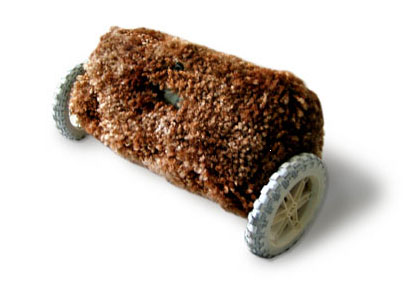

Weird Clocks seem to be everywhere. From a prototype digital clock to Clocky, the digital alarm clock from MIT that intelligently finds a new hiding place each morning so you're forced to get out of bed to turn him off, to the creepy Death Clock.


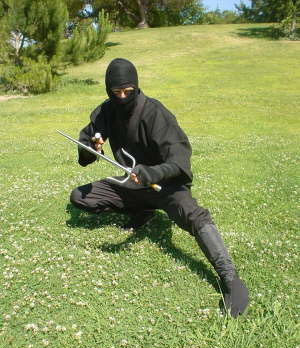
The Purpose of the Ninja is to flip out and kill people. (Sound warning)



Infinite cats! Just what the Internet was made for.

Tuesday, April 26, 2005

Congrats to Fussy Lizard

Fussy Lizard (aka Chris) just finished the MDLM program!

I know personally what a grueling ordeal the program is, and Chris made it through with very impressive stats. Go on over to his blog and congratulate him.