Some highlights:
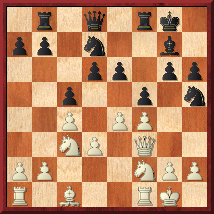
Kilgore (1826) - Kinsler (1893)
White to move
I saw a way to grab a pawn with 14.exf5! exf5 15.Qd5+ Kh7. But now I began to worry that after 16.Qxd6, Black could trap my queen with 16...Bxc3 17.bxc3 Nhf6. Saving the queen (and the won position) is not that hard once you are willing to let her stay on d6 for awhile. For example, 18.Re1 Re8 19.Bd2 Rc8 20.Rxe8 Qxe8 21.Re1. I didn't see all this during the game, so I played 16.Re1?? because taking on d6 looked too scary. Another psychological factor I've experienced before is that initially my plan on extracting my queen was based on 16.Qxd6 Nhf6 17.Nd5, and 16...Bxc3 ruins that idea. Discovering 16...Bxc3 at the last moment, I began to worry that he could indeed trap my queen and didn't stop to make a detailed practical analysis.
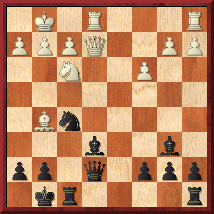
Kostrinsky (1884) - Kilgore (1826)
Black to move
I've gotten myself into a bit of trouble here. White's about to win back his piece and will be a pawn up. Then I found 17...Bxf2+! If 17.Kxf2 then 17...Qc5+ and I can save my light-squared bishop. My opponent played 18.Qxf2 and I got out of the mess with even material. This game should have been a draw, but I misplayed the endgame.
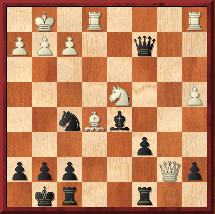
Bedell (1966) - Kilgore (1826)
Black to move
I managed to win a piece after 21...Nxd4 22.Bxd4 Qg6 23.g3 Qd3 24.Re3 (24.Qb2 is better, but allowing my queen to f3 is not an easy thing to do) Qxd4. Confident that I would now beat this 1966 player, I responded to 25.Rae1 with 25...Qxa4?? whereupon he equalized with 26.Qxc8! Ouch. I'll skip the next part where I donated a queen to the cause. One of my worst chess moments ever.
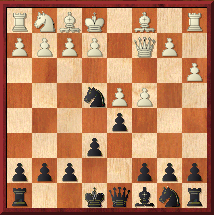
Cano (1866) - Kilgore (1826)
Black to move
Here's a Nimzo-Indian. I played 7...e5, the main line. At the time, having never played this line before, I wondered whether 7...e5 was the right move, or if I was confusing it with another line. I calculated that Black had nice compensation if White takes on e5, and feeling rather reckless from my lackluster tournament performance so far, I decided to go for it and at least go down fighting. The game continued 8.dxe5 Nc6 9.Nf3 Bf5 (the point of 7...e5) 10.Qb3 Na5 11.Qa4+ c6 12.cxd5 Qxd5 13.Be3 Nc4 14.Bd4 b5 15.Qd1.
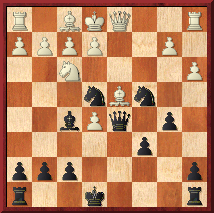
Cano (1866) - Kilgore (1826)
Black to move after 15.Qd1
Now who wouldn't love this type of play with the Black pieces? Later my opponent offered a draw in a position I probably should have played on, but eager to have some positive score where I actually played, I agreed to the draw.


2 comments:
Welcome back!
So is this experience going to drive you deeper into the World of Warcraft or are you returning to a structured study plan?
Or some sort of happy medium?
lol -- I started a structured chess study plan the day after this tournament, in preparation for the next one near the end of October. It's based on tactics, analyzing my own games, and physical conditioning (I'm 45, and physical conditioning plays a greater part than it used to!).
Post a Comment