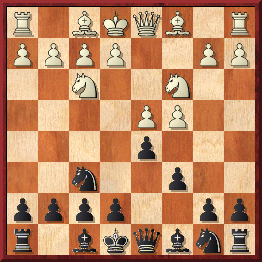
Slav
1.d4 d5 2.c4 c6 3.Nf3 Nf6 4.Nc3
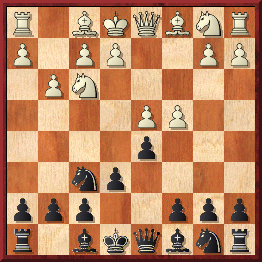
Open Catalan
1.d4 Nf6 2.c4 e6 3.g3 d5 4.Nf3
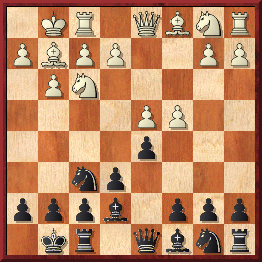
Semi-Open Catalan
1.d4 Nf6 2.c4 e6 3.g3 d5 4.Nf3 Be7 5.Bg2 0-0 6.0-0
What do they all have in common?
A main line move in each position is ...dxc4. What's going on here? Why is Black voluntarily giving White the center by removing that nice pawn on d5 which controls e4?
The answer is time.
In the Slav position, Black wants to develop his light-squared bishop before playing ...e6, but to do so immediately would invite cxd5 followed by Qb3 and Black is in trouble on the queenside light squares. In all three cases, it will take a few moves for White to recapture the c-pawn (in the Catalan positions White has to do so without the light-squared bishop since he wants to fianchetto it). While White is busy getting his pawn back, Black has a little extra time to develop his queenside and bring his pieces to active squares. Sometimes White will truly gambit the pawn and bet that the dynamic activity he gets will more than make up for Black's measly one-pawn advantage.
Is Black's position so cramped that he has to give up the center just for a few tempi? Can't he find a way to develop his pieces and retain the central tension? Won't Black just be worse without any lasting advantage for giving up the center? What is this dynamic compensation that Black receives?
Will you give up a structural/static advantage (or accept a structural/static weakness) for temporary dynamic play? This is a difficult concept to truly grasp and have the confidence and technique to use. After all, if you let your dynamic advantage fade away you're just left with a structural, long-term weakness.
I reached this position in a tournament game:
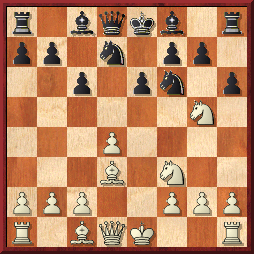
Kilgore - Tillis 2004
Black has just played 7...h6. In case you don't recognize the position, it was also reached in Deep Blue - Kasparov 1997, a game which Kasparov quickly lost. I knew immediately that I was supposed to play 8.Nxe6! White sacrifices material for dynamic compensation in the form of Black's king getting stuck in the middle and a long-lasting initiative. But I sat there and thought for about 15 minutes. A single thought kept going through my head. "Do I have the technique to make this dynamic compensation count?" I finally decided that I would never forgive myself if I chickened out, so I played 8.Nxe6! There's no forced mate or winning back of the material. If I let Black untangle himself, I'm simply down the material.
What would you do?
Do you like to play dynamic chess?
I drew the above game, after winning back the material plus a little more, but in mutual time trouble with a fairly balanced position I played it safe and offered a draw (one thing I am good at in chess is blundering in time trouble). I was still satisfied with the game on some level because I did maintain the initiative for a long time and eventually converted it into a material gain.
Yes, playing dynamic chess is scary, but it's also fun. And I believe it's an essential part of becoming a stronger player at some point.


2 comments:
i like your points. dynamic play is scary but fun.
Gutsy move.
I think dynamic play is great, provided you have enough ideas to make it viable. I never have gotten into something like that so early in a game :-O.
Post a Comment