Monday, November 21, 2005

My Game With Topalov


The sun had just gone down, and the three chess sets were on a long table outside in front of a train car. An excited crowd murmured in anticipation. At table #2 was Mickey Adams and Vishy Anand. At table #3 was Alexander Morozevich and Judit Polgar. And at table #1 sat Veselin Topalov and an empty chair.

I knew it would be a tough game, but soon I would be able to say that I had played the World Champion. I sat down across from Topalov, when he looked at me and said in his Bulgarian accent, "Do I have White or Black?"

"Um..., I'm not sure," I said.

"Do I have White or Black? We can't play until I know."

I looked around for the pairings sheet and found it. Sure enough it said Topalov and I would play on board #1, but it didn't specify the colors. The other pairings had clear notations for who had what color. At the time it didn't seem unusual to me that colors were specified in this way. I only noticed that my game with the chess great was being held up. I frantically started looking for Scott, the TD, to resolve the issue.

The other players started their games. Topalov sat back impatiently. I asked people where Scott was. Nobody could find him!

Time passed and soon the reporters were interviewing Topalov as I sat on top of the train car, dejected. My game with Topalov was not to happen.

And then I woke up.

Wednesday, September 28, 2005

2005 Georgia Class Championship

A rough tournament for me after not playing in several months. I scored a sad 1.5 out of 5 in the A section, and 1 of those points was a full-point bye in round 2. The A-section was small, and I had to play Black three times in a row (not that color choice makes a whole lot of difference at this level).

Some highlights:
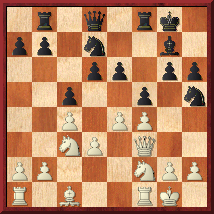

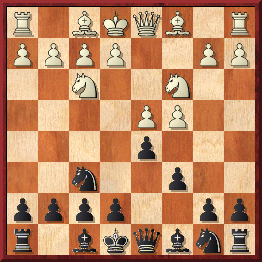
Kilgore (1826) - Kinsler (1893)
White to move

I saw a way to grab a pawn with 14.exf5! exf5 15.Qd5+ Kh7. But now I began to worry that after 16.Qxd6, Black could trap my queen with 16...Bxc3 17.bxc3 Nhf6. Saving the queen (and the won position) is not that hard once you are willing to let her stay on d6 for awhile. For example, 18.Re1 Re8 19.Bd2 Rc8 20.Rxe8 Qxe8 21.Re1. I didn't see all this during the game, so I played 16.Re1?? because taking on d6 looked too scary. Another psychological factor I've experienced before is that initially my plan on extracting my queen was based on 16.Qxd6 Nhf6 17.Nd5, and 16...Bxc3 ruins that idea. Discovering 16...Bxc3 at the last moment, I began to worry that he could indeed trap my queen and didn't stop to make a detailed practical analysis.
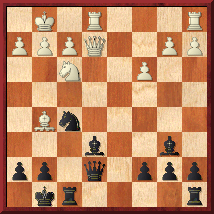

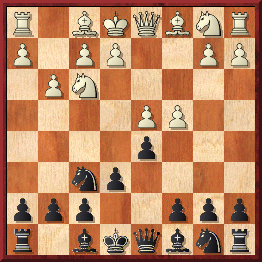
Kostrinsky (1884) - Kilgore (1826)
Black to move

I've gotten myself into a bit of trouble here. White's about to win back his piece and will be a pawn up. Then I found 17...Bxf2+! If 17.Kxf2 then 17...Qc5+ and I can save my light-squared bishop. My opponent played 18.Qxf2 and I got out of the mess with even material. This game should have been a draw, but I misplayed the endgame.
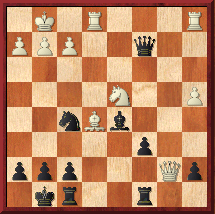

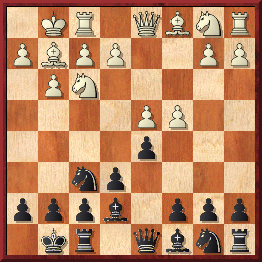
Bedell (1966) - Kilgore (1826)
Black to move

I managed to win a piece after 21...Nxd4 22.Bxd4 Qg6 23.g3 Qd3 24.Re3 (24.Qb2 is better, but allowing my queen to f3 is not an easy thing to do) Qxd4. Confident that I would now beat this 1966 player, I responded to 25.Rae1 with 25...Qxa4?? whereupon he equalized with 26.Qxc8! Ouch. I'll skip the next part where I donated a queen to the cause. One of my worst chess moments ever.
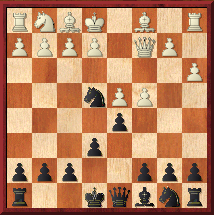

Cano (1866) - Kilgore (1826)
Black to move

Here's a Nimzo-Indian. I played 7...e5, the main line. At the time, having never played this line before, I wondered whether 7...e5 was the right move, or if I was confusing it with another line. I calculated that Black had nice compensation if White takes on e5, and feeling rather reckless from my lackluster tournament performance so far, I decided to go for it and at least go down fighting. The game continued 8.dxe5 Nc6 9.Nf3 Bf5 (the point of 7...e5) 10.Qb3 Na5 11.Qa4+ c6 12.cxd5 Qxd5 13.Be3 Nc4 14.Bd4 b5 15.Qd1.
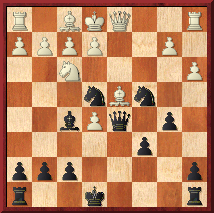

Cano (1866) - Kilgore (1826)
Black to move after 15.Qd1

Now who wouldn't love this type of play with the Black pieces? Later my opponent offered a draw in a position I probably should have played on, but eager to have some positive score where I actually played, I agreed to the draw.
Thursday, August 25, 2005

Gary Southerland

The Georgia chess community lost a long-time chess teacher and tournament director last week. Gary Southerland passed away in his sleep. I did not know Gary very well, but I'd seen him at all the GCA tournaments and spoken with him a few times. The next issue of Georgia Chess magazine will remember Gary. The upcoming Georgia Class Championship is also being named the Rueben Hand, Gary Southerland Memorial. He clearly had a passion for chess, and he will be missed.

Memorial Service Information (to be held August 30)
Newspaper Obituary

Friday, August 12, 2005

Dynamic Play

Consider the following three positions:


Slav
1.d4 d5 2.c4 c6 3.Nf3 Nf6 4.Nc3


Open Catalan
1.d4 Nf6 2.c4 e6 3.g3 d5 4.Nf3


Semi-Open Catalan
1.d4 Nf6 2.c4 e6 3.g3 d5 4.Nf3 Be7 5.Bg2 0-0 6.0-0

What do they all have in common?

A main line move in each position is ...dxc4. What's going on here? Why is Black voluntarily giving White the center by removing that nice pawn on d5 which controls e4?

The answer is time.

In the Slav position, Black wants to develop his light-squared bishop before playing ...e6, but to do so immediately would invite cxd5 followed by Qb3 and Black is in trouble on the queenside light squares. In all three cases, it will take a few moves for White to recapture the c-pawn (in the Catalan positions White has to do so without the light-squared bishop since he wants to fianchetto it). While White is busy getting his pawn back, Black has a little extra time to develop his queenside and bring his pieces to active squares. Sometimes White will truly gambit the pawn and bet that the dynamic activity he gets will more than make up for Black's measly one-pawn advantage.

Is Black's position so cramped that he has to give up the center just for a few tempi? Can't he find a way to develop his pieces and retain the central tension? Won't Black just be worse without any lasting advantage for giving up the center? What is this dynamic compensation that Black receives?

Will you give up a structural/static advantage (or accept a structural/static weakness) for temporary dynamic play? This is a difficult concept to truly grasp and have the confidence and technique to use. After all, if you let your dynamic advantage fade away you're just left with a structural, long-term weakness.

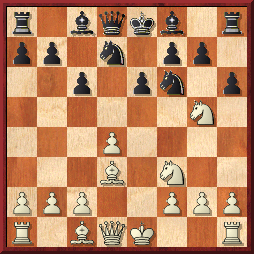
I reached this position in a tournament game:


Kilgore - Tillis 2004

Black has just played 7...h6. In case you don't recognize the position, it was also reached in Deep Blue - Kasparov 1997, a game which Kasparov quickly lost. I knew immediately that I was supposed to play 8.Nxe6! White sacrifices material for dynamic compensation in the form of Black's king getting stuck in the middle and a long-lasting initiative. But I sat there and thought for about 15 minutes. A single thought kept going through my head. "Do I have the technique to make this dynamic compensation count?" I finally decided that I would never forgive myself if I chickened out, so I played 8.Nxe6! There's no forced mate or winning back of the material. If I let Black untangle himself, I'm simply down the material.

What would you do?

Do you like to play dynamic chess?

I drew the above game, after winning back the material plus a little more, but in mutual time trouble with a fairly balanced position I played it safe and offered a draw (one thing I am good at in chess is blundering in time trouble). I was still satisfied with the game on some level because I did maintain the initiative for a long time and eventually converted it into a material gain.

Yes, playing dynamic chess is scary, but it's also fun. And I believe it's an essential part of becoming a stronger player at some point.

Monday, August 08, 2005

Into the Lion's Den


How do you play a superior opponent?

I'm talking about someone rated way above you. 400+ points above you.

Do you play cautiously, trying to survive for as many moves as possible, praying for a draw?

Do you try to make the game as boring as possible, and hope to wear out your opponent?

Do you recklessly go for the kill, figuring that since you'll lose anyway you might as well have some fun?

Or is your approach more subtle, where you basically try to play your best, but:

- You play more conservatively, trying to keep it safe, avoiding complications for fear your opponent can navigate them better.

- You welcome complications, figuring there's more chances for your opponent to mess up.

One thing's for sure: Your higher-rated opponent wants to win. They won't be happy with a draw. Many times this translates into them taking unnecessary risks and making mistakes.

The 2005 Atlanta Chess Center Championship is August 19-21, and it is a little unusual in that the Open section goes all the way down to 1800. This means I'd be playing in the Open section and potentially facing players I've only seen on the upper tables until now.

I've only ever played in an Open section once before, at the 58th Annual Tennessee Open last year. Now that was a blast. Rated 1691 at the time, I beat two experts and gave a FIDE Master a rough time in a long game I eventually lost. I went into each game believing I could beat them all (well, to be honest, I was too nervous at the start of my game with the FM to believe much of anything, so nervous I accidentally knocked over two of my pieces on one of my opening moves!). This was also during the peak of my tactics bootcamp training.

While it's still up in the air as to whether I'll play this upcoming tournament (still recovering from bronchitis, and I don't want to play unless I feel 100%), I can't help but feel an extra element of excitement at the thought of so-called mis-matched pairings in the early rounds of these Open tournaments, because every now and then you get an upset or two.

Friday, July 15, 2005

Peach State WoW

The 2005 Peach State Open is next weekend, July 22-24, and I'll be playing in it.

What chess study and playing have I done since Emory?

Well, I'm afraid I've been sucked into the World of Warcraft, an MMORPG, affectionately known as Warcrack.

At least finally the age old question can be answered: Is Warcraft suitable training for weekend Swiss tournaments?

I'll let you know.


Not me, but you get the idea.

Saturday, June 25, 2005

How To Lose To a Grandmaster in 22 Moves


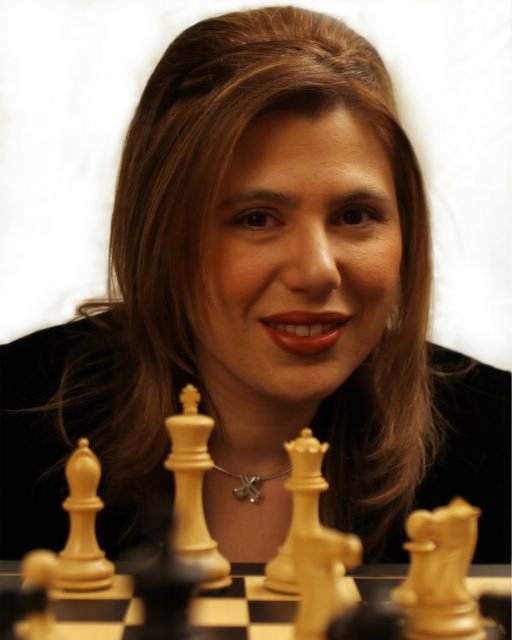
GM Susan Polgar gave a simul last night in Stone Mountain Georgia (just north of Atlanta). This was the first time I've played a GM, much less a world class GM, and it was a lot of fun. I believe she won all the games, and we had some strong players from the House of Pain there to play.

Check out Susan's blog from June 21-25, 2005 for posts with photos of her visit to Atlanta.

You can see how she demolished me here.