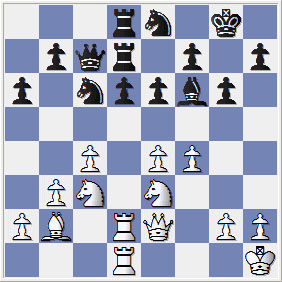
My opponent (Black) just played ...g7-g6. I thought, "He wants to retreat his bishop back to g7 because Ng4 will threaten to capture it or divert it from the a1-h8 diagonal." And I stopped thinking about his move, and missed a game-winning tactic. Can you find it? Solution
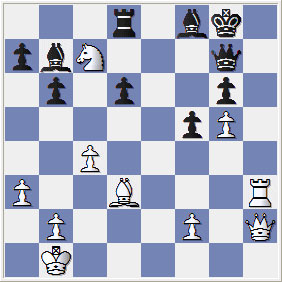
My opponent (White) has apparently just hung a knight on c7. Suspecting a trap, I calculated what would happen if I took the knight, and saw that I could defend against his "threat". And I stopped thinking about it and took the knight. He then showed me the "other" threat that caused me to resign immediately. Do you see how he can win if I take the knight? Solution
In both cases my mind latched onto something and I dismissed further investigation. In the first example, had anyone said, "White has a game-winning tactic here," I could have found it. In the second example had anyone said, "Does White have any other threats?" I could have found it.
Noticing this pattern led me to a simple idea: Always ask, "What else?"
In the first example, "What else has changed because of my opponent's move?" Well, ...g7-g6 removes a defender of the f6-bishop. Is there any way I can exploit this? It's already protected once by the e8-knight. Oh look, Ncd5 attacks the f6-bishop twice and also attacks the queen. Let's calculate some variations.
In the second example, "What else (i.e., forcing moves) can my opponent play?" It has to be forcing since he's sacrificed a piece.
What else... what else... what else...
So I try to keep things simple. My thought process outline goes something like this (always asking what else!):
1) Understand my opponent's move. Understand his idea(s) and what all has changed by the move.
2) Any tactics?
3) Make a strategic plan
4) After deciding on a move, do a final blunder-check.
I'm leaving a lot out here, stuff I already naturally do. But this is the structure I try to impose when I feel I need to. I leave a lot of room in the thought process to go with an idea and see where it takes me. Sometimes I find the right wave and everything flows naturally, and no intentional thought process is needed. So the other area of focus for me is physical conditioning, which includes being able to relax and slow down (while still remaining focused). This seems to help me find those nice waves more often.


7 comments:
So the burning question still remains: how to learn to go through your desired thought process each and every move?
logis had the idea to say it out loud or have an internal dialog about it to help ingrain it. Maybe I will try that. Perhaps I should print my process out and tape it next to the computer monitor to help me remember. Hmmmm.....
Great examples! I like "What else?". Dan Heisman says "calculate until the position is quiet".
Fussy Lizard,
If I could do it, I would tell you how :) The only way I come close is to keep my thought process as simple as possible. For example, in the thought process I gave:
1) Understand my opponent's move. This is something we all do anyway, right? Your opponent moves and you try to understand what they're up to. For me the key here is not to quit too early, not stop looking at it once I've come up with their motivation. Thus, "what else?"
2) Tactical shot? This is something I have to intentionally try and remember to do, rather than solely rely on my recognizing a tactical possibility. Note that, like in my first example from the post, being thorough in step one (noticing that ...g6 removed a defender of the f6-bishop) leads directly to tactical ideas.
3) Strategic plan. This is also a very natural thing to do if there's no tactical shot. It's something I'd already do. I suppose if common strategic themes (e.g., Silman's imbalances) are new to someone, they might want to run through them here.
4) Blunder check. This is the second step I've had to intentionally remember to do. One common technique is to write down your move before making the move and then do a blunder check.
So in all there's really just two "steps" I need to try to remember to do every move: tactical shot? and blunder check. And an overall "what else" all the time. I don't know what thought process you use, but I think it needs to be fairly simple. When I feel "balanced" and healthy, I find I do the entire thing naturally anyway: I find myself always looking for tactical opportunities and when my hand is ready to reach for a piece I start looking for anything I may have missed.
I think logis' idea is a good one. You can even say everything into a tape recorder and you might be surprised when you listen to the tape! I've worked with a printout before (although that was with a fairly elaborate process) -- still not easy for me to always use it.
Thanks, King of the Spill! Sounds like good advice from Heisman. He's one of the few teachers out there who goes into depth about thought process.
I try to understand my opponent's moves and then test them in the crucible of tactics. Why did s/he make that move? What is he aiming for? Then, the tactics question becomes "does it work?"
Again a nice post, must remember to put your blog in my link section.
A good book to read to help improve your thoughtproces, well i personally find it a good book, is:
improve your chess NOW from GM Jonathan Tisdall.
Another book which covers also the thoughtproces but i find it not so good written as the Tisdall book is: Practical chess analysis from Mark Buckley (USCF senior master).
And don't calculate with dry variants (1. d4 d5 2. Nf3 Nf6 3. Nc3 ...) but use words (oke, i open with my queens pawn. Intresting, he reacts with his queens pawn two moves forward aswell. Let's put a knight out now. Hmmm, Nf6, a symetric position if i now play ...). Afterall, its easier to remember conversations then mathematics. Just think of all that unusefull gossip you still remember.
But now i stop giving out my secrets because next i know you guys show me all the side of the chessboard. :)
Hope this helps,
logis
http://logis.modblog.com
Ps. I am sure if you look around at chessville (http://www.chessville.com ) you will find a review of the book from Tisdall.
Forgot to ask with what program you made your diagrams.
logis
http://logis.modblog.com
I have Tisdall's book (I have way too many chess books!) and I like it. In particular his discussion of "stepping stone diagrams" is very helpful for calculation. I also like what John Nunn has to say in Secrets of Practical Chess.
I'm using Chessbase 9's output to HTML/Javascript feature, then I just grab the screen image of the position into Photoshop (any image editor would do).
Post a Comment